How to check if your First Touch Attribution works?

Many analytics tools claim to show First Touch attribution. It is the most effective measure of demand generation. But in practice, most of them are silently broken. Because customer journeys happen across multiple browser, devices and domains Without identity stitching and data enrichment, platforms lose early touchpoints and end up recording only the last visible session. So what gets labeled as First Touch is often just Last Touch in disguise.

Setup & Data

Setup & Data

We looked at a Brand’s Channel Attribution across 3 Models

  1. Standard First Touch - First Touch, No identity Stitching

  2. Standard Last Touch - Last Touch, No identity Stitching

  3. Enriched First Touch - First Touch with Identity Stitching & User Journey Enrichment

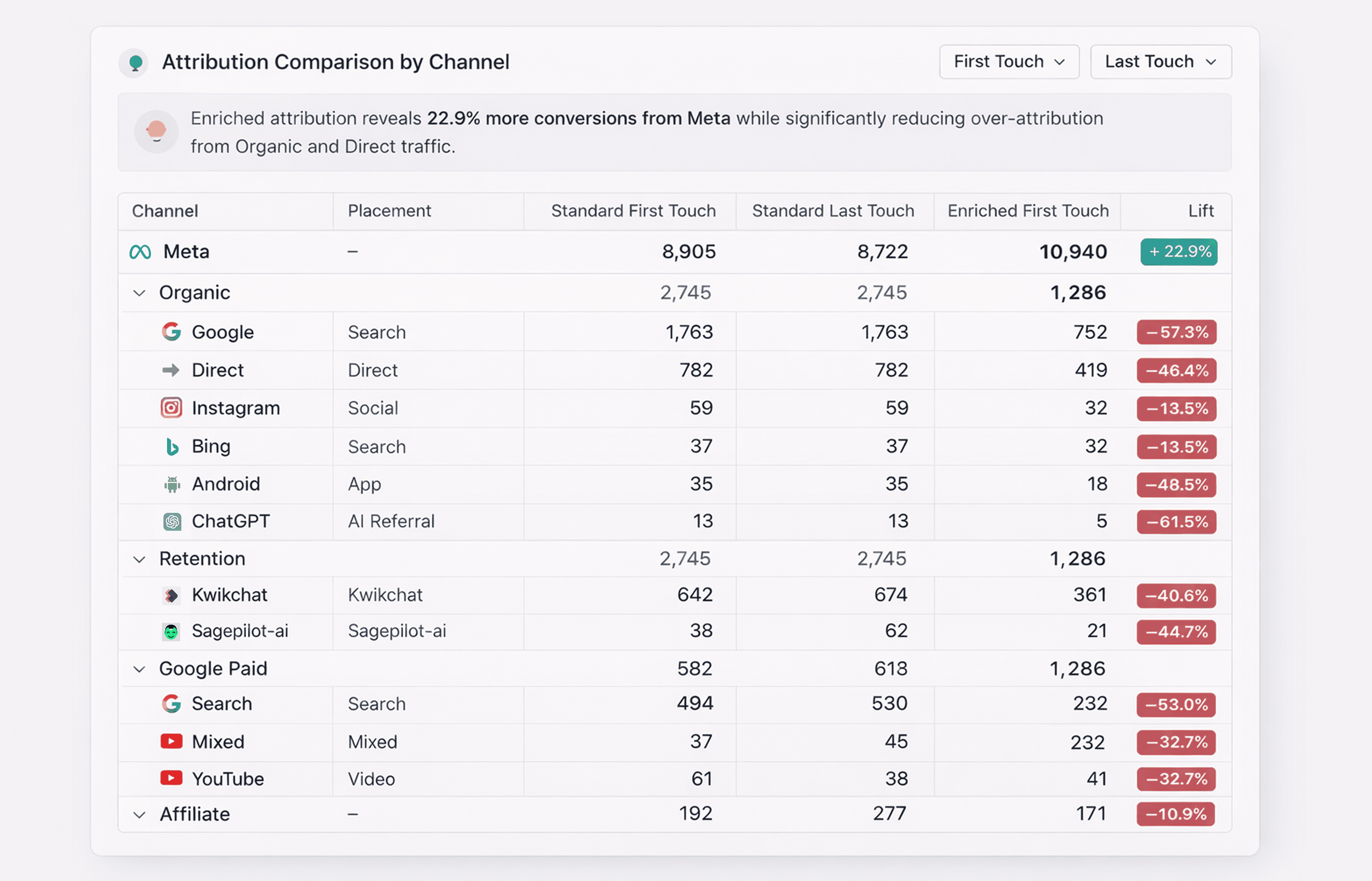
Here are the results for 30 Days for a Lifestyle Brand
Analysis

Analysis

The above data shows a ton of signals highlighting why Standard First Touch is broken. If you want to check whether your attribution has issues, look for the signals.
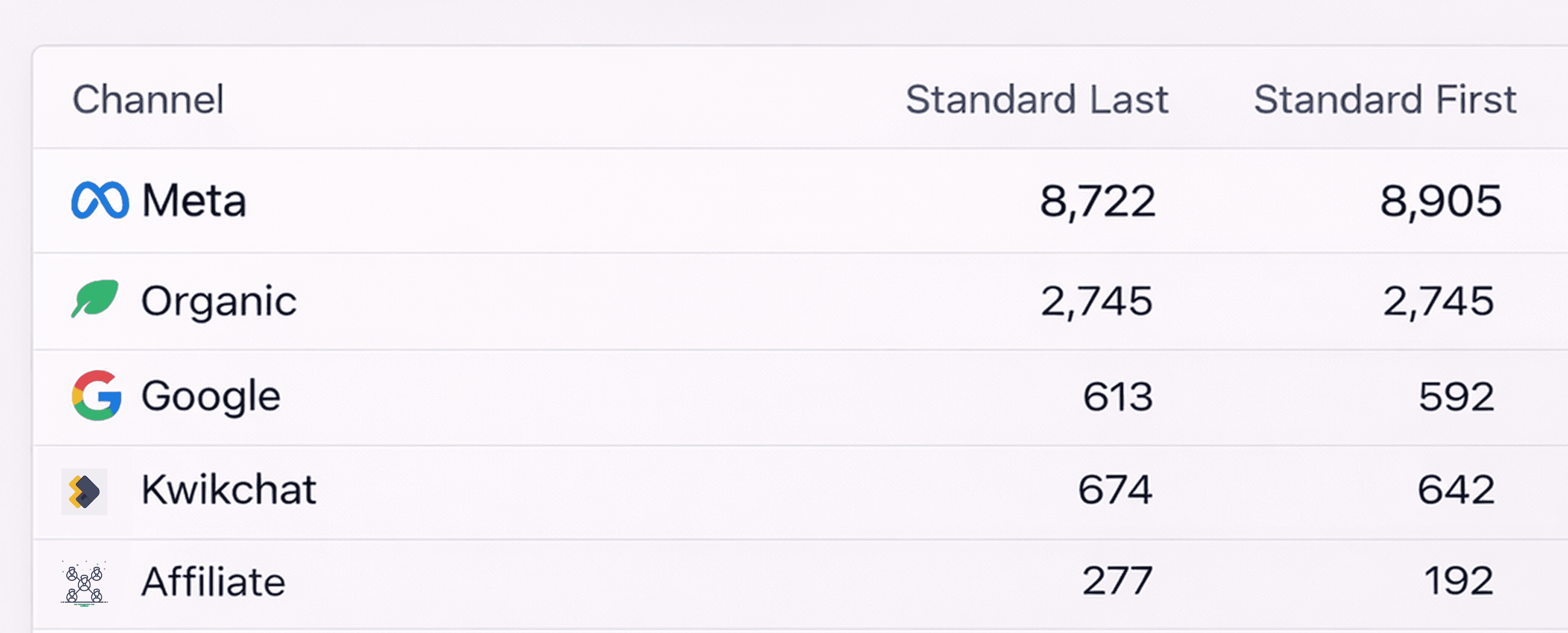
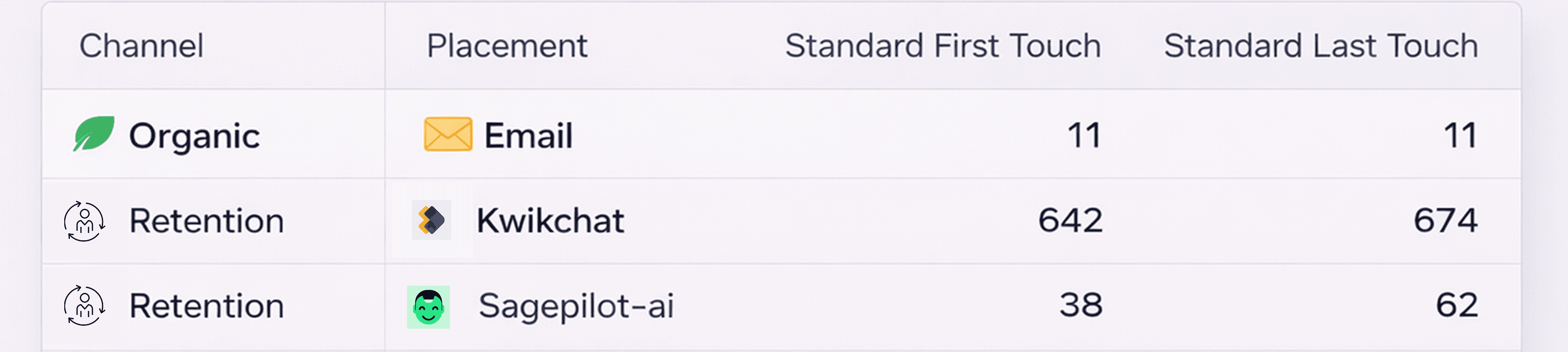
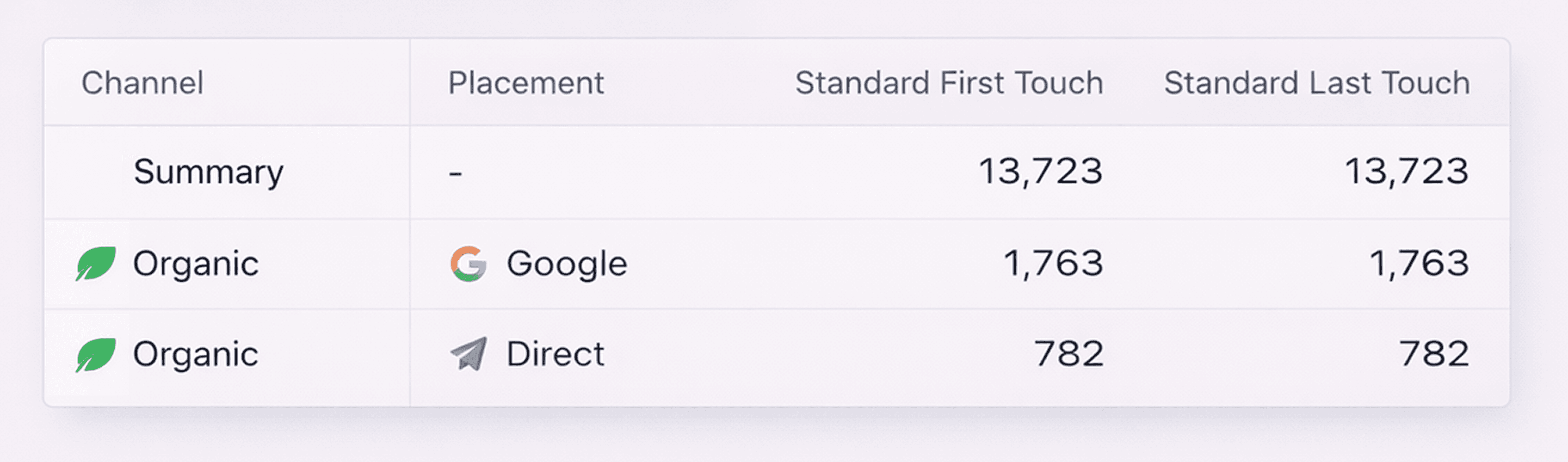
1. First Touch looks almost identical to Last Touch

If they looks similar. That’s a red flag 🚩 🚩

In real funnels:

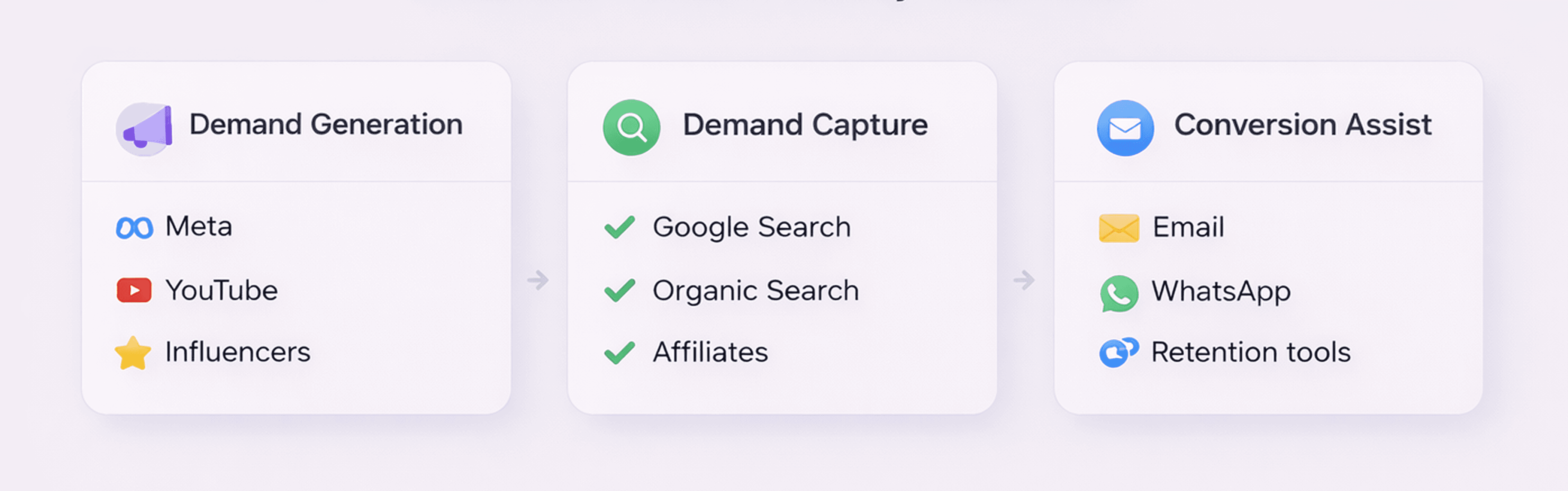
  • some channels generate demand

  • some channels capture demand

If your First Touch ≈ Last Touch, it usually means the earlier touchpoints were lost.

2. Retention channels dominate in First Touch as well

Another major signal.

If your First Touch report contains things like:

  • Email

  • WhatsApp

  • SMS

  • CRM tools

  • Loyalty apps

  • Retargeting chat widgets

Something is wrong. 🚩 🚩

These channels cannot realistically be the first interaction with your brand.

They typically appear after the customer already knows you.

Seeing them in First Touch means the true discovery source was never recorded.

3. Organic search looks too strong

This is another common distortion. 🚩

Why?

Because many journeys look like this:

Meta Ad → Browse → Leave

(User Journey Breaks)

Google brand search → Purchase

Standard First Touch credits Organic Search.

But organic didn’t create the demand.

It only captured existing intent.

4. Brand search drives a huge share of “new customers”

If brand search appears as a major discovery channel, it’s another clue. 🚩

People rarely discover brands by already searching for the brand name.

Brand search is usually a late-stage conversion event.

5. Direct traffic is unusually high

Direct traffic often becomes a garbage bucket for lost attribution.

If you see: more than 10% Direct conversions. It’s a red flag. 🚩 🚩

There’s a good chance those journeys actually started with:

  • Meta

  • YouTube

  • Influencers

  • Content

But the early touchpoints were lost.

What Real Funnels Usually Look Like?

If your attribution platform shows everything behaving the same across First Click and Last Click, it means it can’t see the real journey.

And if attribution is wrong, budget decisions will also be wrong.
What does Enriched First Touch reveal?

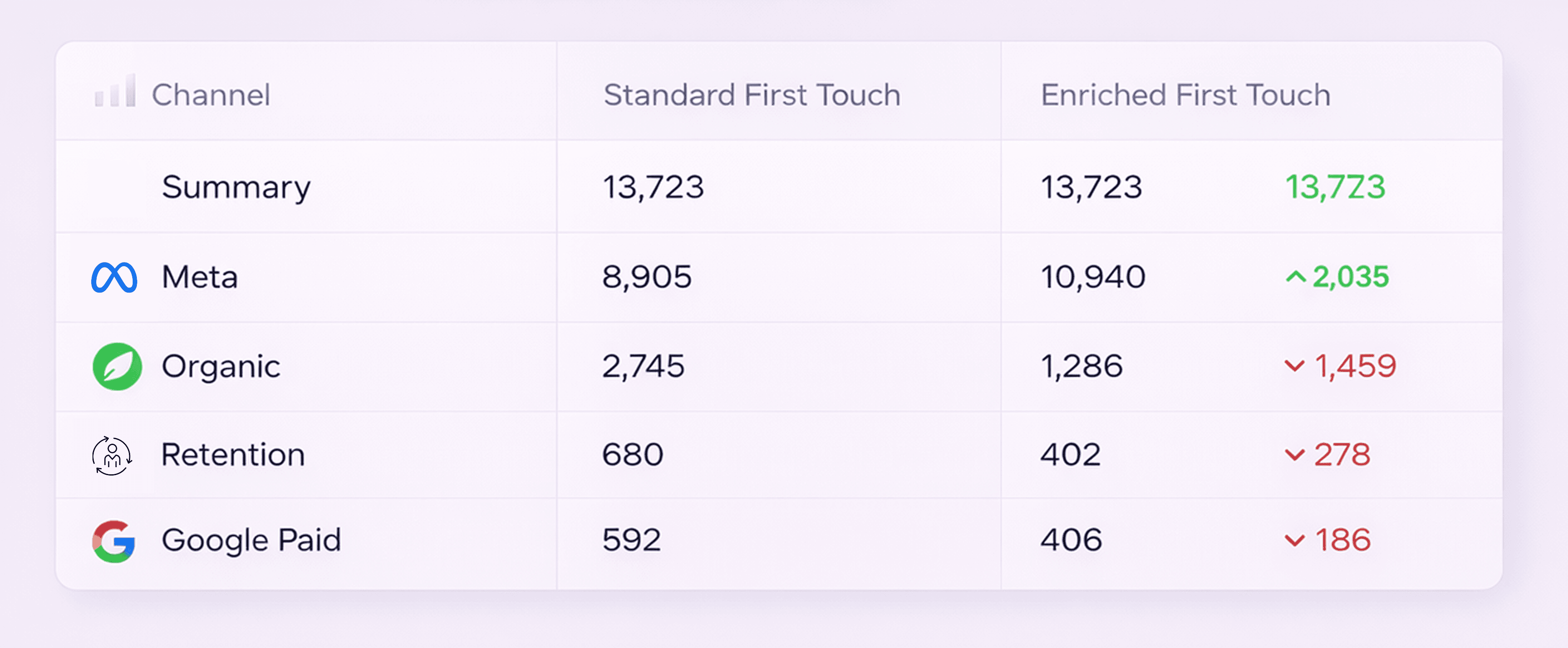
Meta gains ~2,000+ additional first touches

Meta is generating much more initial demand than standard analytics shows.

Nearly 1,460 orders were wrongly attributed to organic.

Organic inflation disappears

Meta is actually responsible for ~80% of demand generation.

Meta's true role becomes visible

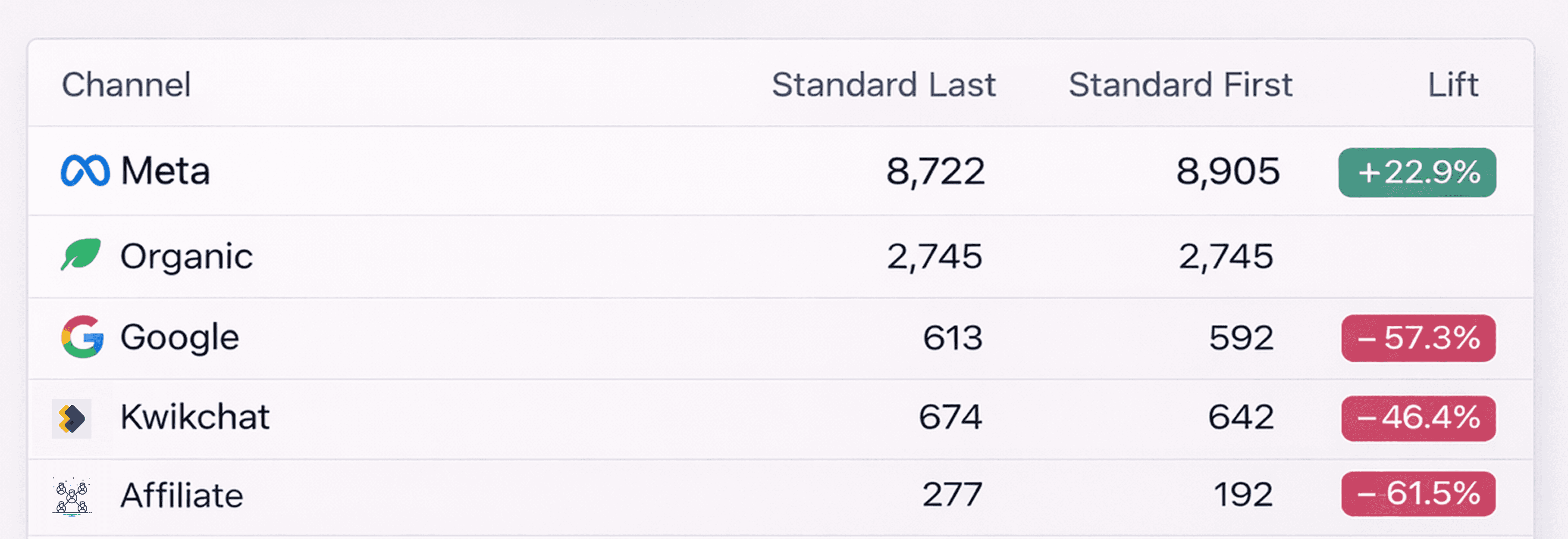
Google share is adjusted by 31%.

Search (494 → 232) losing more than half it share and Display Networks (37 → 133) gaining visibility.

Is this Perfect?

No, there are two factors to consider here.

  1. Coverage - How many broken User Journeys are we fixing.

  2. Accuracy - How accurately are we mapping Sessions to Users.

If we try to increase Coverage → Accuracy goes down.

It is not possible to stitch 100% of the User Journeys with 100% accuracy. We call it Attribution’s Uncertainty Principle.

The BooleanMaths Approach

At BooleanMaths we prioritise accuracy first.

We maintain ~95% confidence in identity stitching, which naturally limits how many journeys can be reconstructed.

At this accuracy level, our coverage stabilises around ~50% of broken journeys.

This means we fix a large portion of attribution loss without introducing noisy or incorrect matches.

Find out how BooleanMaths can help you enrich your sessions.

Find out how BooleanMaths can help you enrich your sessions.

Is this Perfect?

No, there are two factors to consider here.

  1. Coverage - How many broken User Journeys are we fixing.

  2. Accuracy - How accurately are we mapping Sessions to Users.

If we try to increase Coverage → Accuracy goes down.

It is not possible to stitch 100% of the User Journeys with 100% accuracy. We call it Attribution’s Uncertainty Principle.

The BooleanMaths Approach

At BooleanMaths we prioritise accuracy first.

We maintain ~95% confidence in identity stitching, which naturally limits how many journeys can be reconstructed.

At this accuracy level, our coverage stabilises around ~50% of broken journeys.

This means we fix a large portion of attribution loss without introducing noisy or incorrect matches.

1. First Touch looks almost identical to Last Touch

If they looks similar. That’s a red flag 🚩 🚩

In real funnels:

  • some channels generate demand

  • some channels capture demand

If your First Touch ≈ Last Touch, it usually means the earlier touchpoints were lost.

2. Retention channels dominate in First Touch as well

Another major signal.

If your First Touch report contains things like:

  • Email

  • WhatsApp

  • SMS

  • CRM tools

  • Loyalty apps

  • Retargeting chat widgets

Something is wrong. 🚩 🚩

These channels cannot realistically be the first interaction with your brand.

They typically appear after the customer already knows you.

Seeing them in First Touch means the true discovery source was never recorded.

3. Organic search looks too strong

This is another common distortion. 🚩

Why?

Because many journeys look like this:

Meta Ad → Browse → Leave

(User Journey Breaks)

Google brand search → Purchase

Standard First Touch credits Organic Search.

But organic didn’t create the demand.

It only captured existing intent.

4. Brand search drives a huge share of “new customers”

If brand search appears as a major discovery channel, it’s another clue. 🚩

People rarely discover brands by already searching for the brand name.

Brand search is usually a late-stage conversion event.

5. Direct traffic is unusually high

Direct traffic often becomes a garbage bucket for lost attribution.

If you see: more than 10% Direct conversions. It’s a red flag. 🚩 🚩

There’s a good chance those journeys actually started with:

  • Meta

  • YouTube

  • Influencers

  • Content

But the early touchpoints were lost.

What does Enriched First Touch reveal?

Meta gains ~2,000+ additional first touches

Meta is generating much more initial demand than standard analytics shows.

Nearly 1,460 orders were wrongly attributed to organic.

Organic inflation disappears

Meta is actually responsible for ~80% of demand generation.

Meta's true role becomes visible

Google share is adjusted by 31%.

Search (494 → 232) losing more than half it share and Display Networks (37 → 133) gaining visibility.